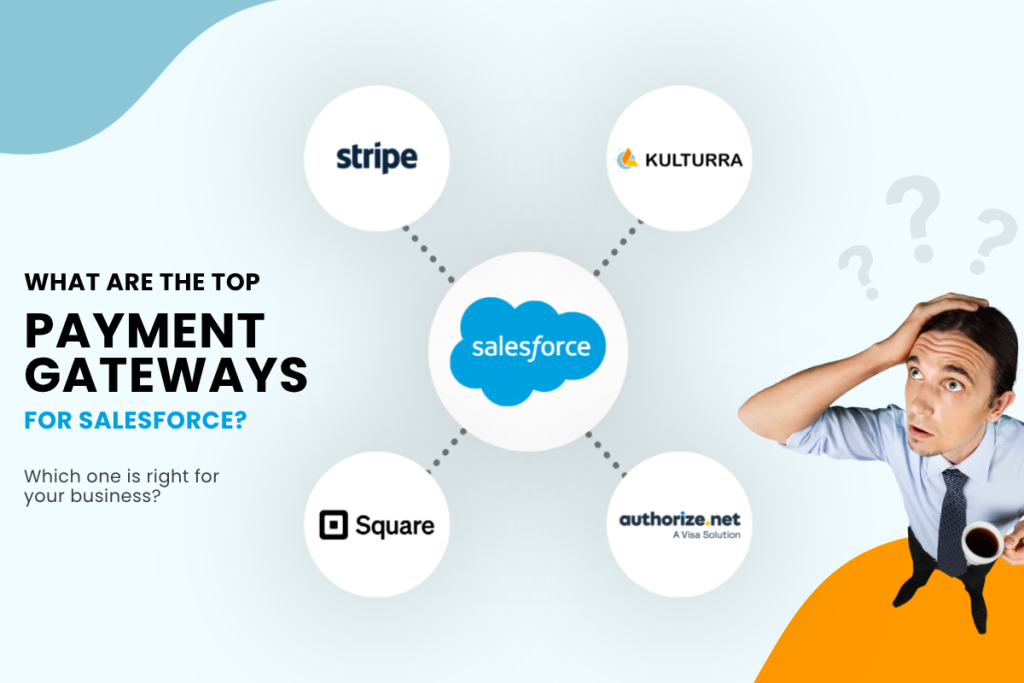
Stripe, Authorize.net, Square, and payment processors such as Kulturra can all play a role in a Salesforce payment strategy. The best option depends on your transaction volume, payment requirements, pricing, and Salesforce workflows.
If your organization wants to accept payments within Salesforce, there are two key decisions to make:
- Which payment provider or gateway should process the transaction?
- How will that payment provider connect to Salesforce?
These are related but separate decisions. A payment gateway connects transactions to the payment-processing network, while a Salesforce payment application or integration connects that payment infrastructure to Salesforce.
Salesforce supports several approaches to payments, including Salesforce Payments, AppExchange payment providers, and custom integrations.
For businesses evaluating payment gateways for Salesforce, four options are worth considering:
Stripe
Stripe is one of the most widely adopted payment platforms and has a strong developer ecosystem. Stripe also offers Salesforce integration options through AppExchange.
Advantages
- Fast and relatively straightforward onboarding
- Modern APIs and developer tools
- Broad payment ecosystem
- Strong online payment capabilities
- Familiar platform for many businesses
Considerations
Stripe is attractive because of its simplicity, but businesses should evaluate its total processing costs against alternatives.
High-volume organizations may want to compare standard pricing with negotiated rates available through other payment providers. Businesses should also evaluate whether their Salesforce integration supports the payment workflows they need, such as recurring payments, payment plans, invoicing, and payment portals.
Best for
Businesses that prioritize fast deployment, modern payment infrastructure, and a familiar technology ecosystem.
Authorize.net
Authorize.net is an established payment gateway that has been widely used for online and card-not-present transactions.
One advantage is its compatibility with different merchant-account arrangements. Authorize.net is also supported by multiple Salesforce payment applications.
Advantages
- Established payment gateway
- Broad compatibility
- Flexible merchant-account arrangements
- Supported by multiple Salesforce payment solutions
- Suitable for businesses seeking payment-processing flexibility
Considerations
Depending on the setup, businesses may work with a merchant account provider, Authorize.net, and a separate Salesforce payment application.
That structure is not necessarily a disadvantage, but businesses should understand who is responsible for each part of the payment environment.
Best for
Businesses that want an established gateway with flexibility around their merchant-account and processing relationship.
Square
Square is best known for combining payment processing, point-of-sale functionality, and commerce tools.
This can make it particularly attractive to businesses already using Square for in-person and online payments. Salesforce currently provides a Square Connector through MuleSoft for Flow, while Square provides APIs for custom integrations.
Advantages
- Strong point-of-sale ecosystem
- Online and in-person payment capabilities
- Useful for existing Square customers
- APIs available for custom integrations
- Salesforce connector options are available
Considerations
Square should not necessarily be evaluated in exactly the same way as Stripe or Authorize.net.
For businesses looking for a Salesforce-native payment workflow, the key question is how the Square integration will be implemented and what Salesforce functionality it supports.
Best for
Businesses already using Square, particularly those combining online and in-person payments.
Payment Agents and Salesforce Payment Providers
Another option is to work with a payment agent, Independent Sales Organization (ISO), or Salesforce payment provider that can help with both payment processing and Salesforce integration.
This approach can be especially useful for organizations that:
- Process significant payment volumes
- Want help negotiating payment processing rates
- Need assistance obtaining a merchant account
- Have complex Salesforce payment workflows
- Want ongoing payment support
- Prefer working with one primary provider
Instead of selecting a payment gateway first and then managing separate providers, a payment agent can help businesses evaluate the overall payment setup, including merchant accounts, payment processing, gateway options, and Salesforce integration.
Advantages
Help negotiating payment processing rates
One of the biggest advantages of working with a payment agent is that they can help negotiate payment processing rates on behalf of your business.
Depending on transaction volume, industry, and merchant profile, a payment agent may be able to work with payment partners to help secure more competitive processing rates than a business might receive through standard pricing.
Merchant account assistance
Payment agents can help businesses evaluate and obtain merchant-account services without requiring them to navigate the process alone.
Salesforce expertise
A Salesforce-focused payment provider understands both payment processing and Salesforce implementation, helping businesses connect their payment workflows to their CRM.
One point of contact
Businesses can reduce the number of vendors involved by working with one primary provider for payment onboarding, Salesforce integration, and ongoing support.
More flexibility
Depending on the provider, businesses may have access to multiple payment gateways and processing options rather than being limited to a single platform.
Considerations
Not all payment agents or ISOs operate the same way. Before signing an agreement, review:
- Processing rates
- Monthly and gateway fees
- Contract length
- Early termination fees
- Monthly minimums
- Chargeback fees
- Support arrangements
- Supported Salesforce functionality
- Available payment gateways
Example: Kulturra for Salesforce Payments
Kulturra takes a different approach from a traditional standalone payment gateway.
Kulturra provides a Salesforce payment application and can also help organizations with their payment-processing setup.
Its Salesforce AppExchange listing includes support for credit card and ACH payments, invoicing, subscriptions and recurring payments, in-person payments, automated reminders, payment portals, multi-entity support, and 120+ gateways.
This means businesses do not necessarily have to choose between “use Stripe” and “use Kulturra.”
Kulturra can provide the Salesforce payment layer while the business continues using a supported gateway.
If you already use Stripe or Authorize.net
Changing payment providers may not be necessary.
A Salesforce payment application that supports your existing gateway can connect payment activity to Salesforce while allowing you to maintain your existing payment relationship.
If you have not selected a gateway
Kulturra can help organizations evaluate their payment-processing options and implement a Salesforce payment solution.
This can simplify the process of selecting a merchant account, payment gateway, and Salesforce integration.
Why work with a Salesforce payment provider?
Payment processing involves more than connecting an API. Businesses may need to consider:
- Merchant accounts
- Processing rates
- Recurring payments
- Payment plans
- Tokenization
- Payment security
- PCI compliance
- Reconciliation
- Refunds and chargebacks
- Salesforce automation
- Customer payment portals
A provider that understands both Salesforce and payments can help reduce the number of vendors and handoffs involved.
Salesforce Payment Gateway Comparison
| Option | Best For | Pricing | Main Advantage | Key Consideration |
|---|---|---|---|---|
| Stripe | Businesses prioritizing modern payment infrastructure | Typically flat-rate; volume discounts may be available | Simple onboarding and strong API ecosystem | May not be the lowest-cost option for high-volume businesses |
| Authorize.net | Businesses wanting gateway and merchant-account flexibility | Varies by merchant account and processing setup | Established platform and broad compatibility | May involve multiple vendors and fees |
| Square | Businesses already using Square | Typically flat-rate; varies by payment method | Strong online and in-person payment ecosystem | Pricing and features vary by transaction type |
| Payment Agent (Kulturra) | Businesses wanting Salesforce payment workflows and gateway flexibility | Customized based on payment setup and requirements | Can help negotiate payment processing rates, provide a Salesforce payment application, offer multiple gateway options, and provide ongoing support | Specific pricing depends on gateway, processing, and requirements |
How Should You Choose a Payment Gateway for Salesforce?
Before choosing a provider, consider:
What payment methods do you need?
Determine whether you need credit cards, ACH, digital wallets, recurring payments, or in-person payments.
What is your transaction volume?
Smaller businesses may prioritize simple pricing, while high-volume organizations may benefit from negotiated processing rates.
Do you already have a merchant account?
If you already have a payment provider, determine whether it can connect to your preferred Salesforce payment application before switching.
Do you need more than basic payment processing?
Consider whether you need recurring payments, payment plans, installments, invoicing, payment links, payment portals, automated reminders, or reconciliation.
Who will support the integration?
Understand whether Salesforce, the gateway, merchant account provider, or Salesforce payment application will handle implementation and support.
Frequently Asked Questions
What is the best payment gateway for Salesforce?
There is no single best payment gateway for Salesforce. Stripe, Authorize.net, Square, and other providers can be appropriate depending on transaction volume, payment methods, merchant-account requirements, Salesforce workflows, and pricing.
Does Stripe integrate with Salesforce?
Yes. Stripe offers Salesforce integration options, including a Salesforce Platform application available through AppExchange.
Does Authorize.net integrate with Salesforce?
Yes. Authorize.net is supported by multiple Salesforce payment applications available through AppExchange.
Does Square integrate with Salesforce?
Yes. Salesforce provides a Square Connector through MuleSoft for Flow, and Square provides APIs for custom integrations.
The specific implementation depends on the Salesforce environment and functionality required.
Can I keep my existing payment gateway when adding a Salesforce payment solution?
In many cases, yes. The key is choosing a Salesforce payment application that supports your existing gateway and required payment workflows.
Do I need a payment gateway and a Salesforce payment application?
It depends on your Salesforce setup. Salesforce supports multiple payment approaches, including Salesforce Payments, AppExchange providers, and custom integrations.
For many organizations, a Salesforce payment application provides the connection between Salesforce and the underlying payment infrastructure.
What is the advantage of using a payment agent for Salesforce payments?
A payment agent can help with merchant-account selection, payment processing, pricing, onboarding, and support. When the provider also specializes in Salesforce payments, businesses can potentially work with one team for both payment processing and Salesforce integration.
What is Kulturra?
Kulturra is a Salesforce payment solution that helps businesses process and manage payments within Salesforce. Its AppExchange listing includes credit card and ACH payments, invoicing, recurring payments, in-person payments, automated reminders, payment portals, multi-entity support, and 120+ gateway integrations.
Should I choose Stripe, Authorize.net, or Square for Salesforce?
Choose Stripe if you prioritize a modern payment platform and streamlined onboarding.
Choose Authorize.net if you want an established gateway and flexibility around merchant-account relationships.
Choose Square if your business already relies on Square for online or in-person payments.
Consider a Salesforce payment provider such as Kulturra if you want help evaluating payment infrastructure while also implementing a Salesforce payment solution.
What should I look for in a Salesforce payment solution?
Look beyond the gateway itself. Evaluate supported payment methods, recurring payments, payment plans, invoicing, payment links, portals, tokenization, reconciliation, security, Salesforce functionality, implementation, and ongoing support.
Final Thoughts
The best payment gateway for Salesforce depends on more than the gateway itself. Stripe, Authorize.net, Square, and Salesforce payment providers such as Kulturra each offer different advantages.
For many businesses, the best approach is to evaluate the entire payment solution, from the gateway and merchant account to the Salesforce integration and ongoing support.